

We are gearing up for the 2026 ASCO (American Society of Clinical Oncology) Annual Meeting in just a few weeks but in the meantime, the 2026 ESMO (European Society of Medical Oncology) Breast Meeting just happened in early May in Berlin. I have been following along with the studies presented so let’s dive in! This is Part 1: SERDs in early stage HR+/HER2- BC, ctDNA in early stage HR+/HER2- BC and the antibody drug conjugate, Trodelvy, in HER2+ MBC. (More in part 2 soon!)

(I took this photo when I was in Berlin for the 2025 ESMO meeting).
SERDs in Early Stage Breast Cancer: PREcoopERA Trial
One of the hottest topics in breast cancer right now is SERDs (selective estrogen receptor degrader) in early stage breast cancer. The lidERA trial was presented in December 2025 looking at the SERD, giredestrant, as adjuvant endocrine therapy in ER+/HER2 negative early stage breast cancer. For more information on the lidERA trial, check out my video here. Giredestrant binds to the estrogen receptor and induces a change in it that not only blocks the estrogen receptor but breaks it down as well. SERDs are approved currently in metastatic breast cancer (elacestrant, imlunestrant) but this was the first big study for SERDs presented in early stage breast cancer (others are ongoing). In the lidERA trial, over 4000 patients with stage I-III breast cancer were randomized to receive giredestrant (daily oral medication) or endocrine therapy with tamoxifen or an aromatase inhibitor. Ovarian suppression was required for premenopausal women on giredestrant or aromatase inhibitor. Giredestrant reduces the risk of invasive disease recurrence or death (invasive disease free survival) by 30%. Patients were followed for about 32 months on average: 89.6% were alive without recurrence with AI or tamoxifen compared to 92.4% with giredestrant (about 3% absolute benefit). There appeared to be less discontinuation of giredestrant due to musculoskeletal symptoms (such as joint pain) compared to discontinuation of endocrine therapy. *Giredestrant is not yet FDA approved.
The results of the PREcoopERA window-of-opportunity trial were presented at ESMO Breast. 204 premenopausal patients with untreated ER+/HER2- stage I-III breast cancer (and Ki67 >10%, this is a marker of proliferation) received 4 weeks of preoperative treatment with:
Giredestrant plus triptorelin (triptorelin results in ovarian function suppression, similar to Lupron or Zoladex)
Anastrozole plus triptorelin
Giredestrant alone (without ovarian suppression)
One of the reasons this is important is that giredestrant was only studied with ovarian suppression in the lidERA trial and a big question has been will giredestrant be able to be used without ovarian suppression? The primary endpoint of the study was centrally assessed change in Ki67 between baseline and post-treatment biopsy or surgery. The study found that all three treatment approaches reduced Ki67:
Mean change of -79.6% with giredestrant + ovarian suppression
Mean change of -73.7% with anastrozole + ovarian suppression
Mean change of -68.2% with giredestrant alone
There was no statistically significant difference between giredestrant/OFS and anastrozole/OFS. Researchers wanted to see whether giredestrant alone was non-inferior (meaning “not worse”) than giredestrant or AI with ovarian function suppression and they could not prove that. You can see that although giredestrant has activity on its own, it did not do as well when given alone without OFS, at least in terms of change in Ki67. Importantly, these are early biologic response data — not long-term recurrence or survival outcomes but is helpful information as we think about the development of SERDs in early stage breast cancer. We do not yet know when giredestrant will be considered by the FDA. The FDA has accepted a new drug application for giredestrant in metastatic breast cancer with a deadline expected by the end of December 2026 but we don’t have any information yet for FDA consideration of giredestrant in early stage BC (consideration in MBC will likely come first).
ctDNA in HR+/HER2- Early Stage Breast Cancer: TRAK-ER Study
I recently shared some updates on circulating tumor DNA in HER2 positive and triple negative breast cancer in this Substack here (and I explain ctDNA and some of the challenges with it).
The TRAK-ER study presented at ESMO Breast looks at the use of ctDNA in HR+/HER2- breast cancer. Patients with high-risk disease underwent ctDNA surveillance every 3 months for 3 years. Patients had to be on endocrine therapy for at least 6 months, but no longer than 7 years. If ctDNA was detected, patients had staging imaging and if there was no evidence of cancer on imaging, they were randomized to either continue their endocrine therapy or receive Faslodex (an injectable SERD) and Ibrance (a CDK 4/6 inhibitor). They presented data on 900 patients:
ctDNA was detected in 11.6% (105/901) of patients.
42.9% of patients already had recurrent disease on imaging at the time of ctDNA detection (45/105) and 39 of those (86.7%) had metastatic disease and 5 had a local recurrence (data missing for 1 patient). The likelihood of already having recurrent disease on imaging was greater if ctDNA was detected at the initial test compared ctDNA detection on subsequent tests.
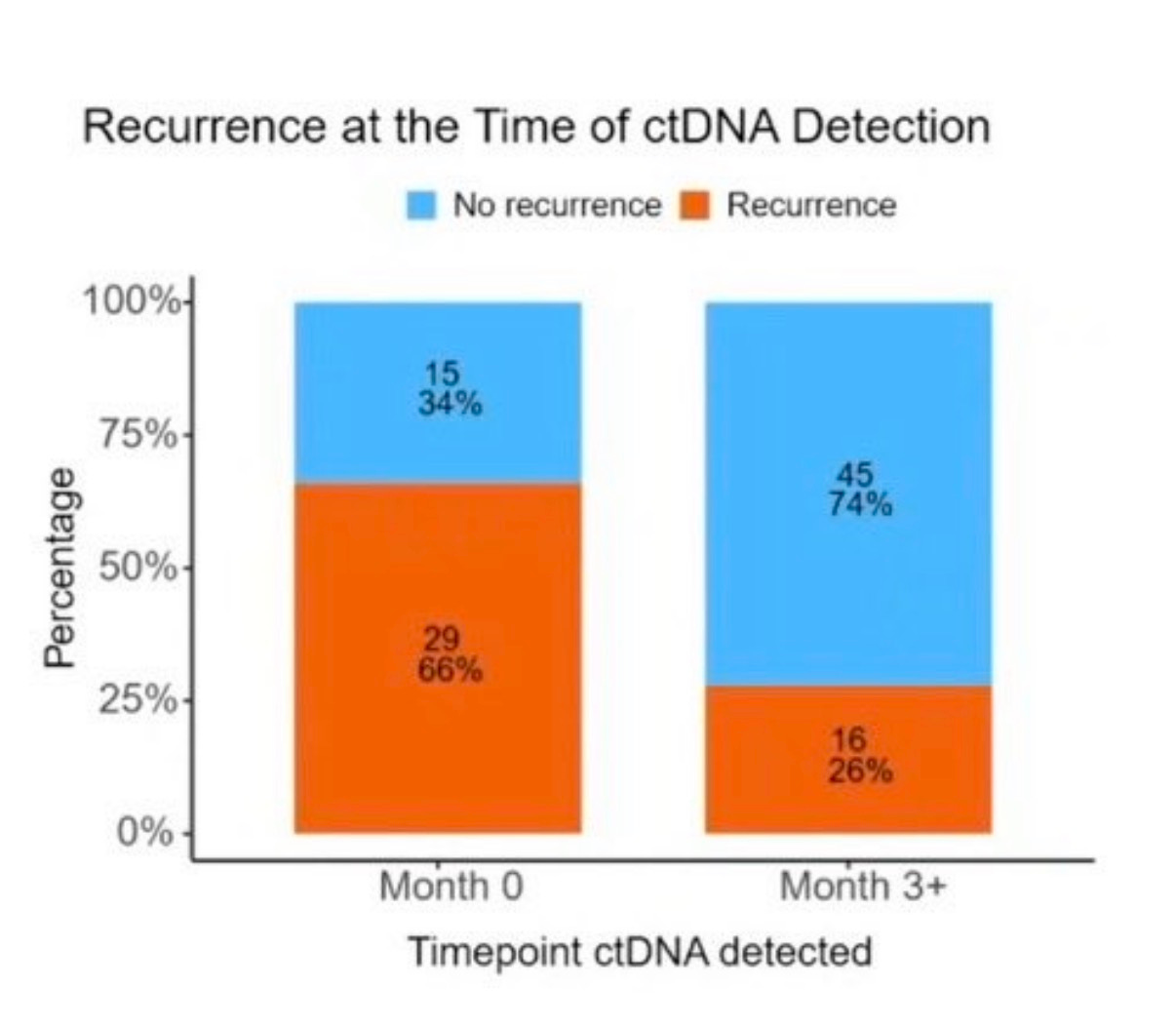
ctDNA detection was numerically more frequent with higher nodal stage, in patients with stage IIIC disease, and lower in grade 1 tumors. We don’t yet have data on the outcomes from the second half of the study where patients with positive ctDNA and no evidence of disease on imaging are randomized to Faslodex/Ibrance vs continuing with their standard therapy. This adds to the growing data that ctDNA testing is prognostic: the test may detect molecular relapse before scans do, but the questions remain:
Does changing treatment at the time of ctDNA detection improve outcomes?
Is there an effective therapeutic intervention for positive ctDNA and what is it?
There are also practical challenges. The overall ctDNA detection rate was low: 1.87% (107/5,724 samples), meaning many patients needed repeated testing to identify a relatively small number of positive cases. In addition, this type of personalized ctDNA testing requires enough tumor tissue from the original cancer to create an individualized blood test, and in this study, researchers were unable to successfully develop that test in 16.1% of patients.
Every time we have new ctDNA data, it raises a lot of questions about routine ctDNA testing, especially in patients at higher risk of recurrence. At this time, I believe it remains an individual decision. We have established that it gives us prognostic information and so for some, ctDNA can be a helpful tool to have that information. However, I always counsel my patients that while a negative ctDNA is reassuring, you have to be prepared for the implications of a positive ctDNA. I am encouraged by many ongoing clinical trials looking at interventions based on ctDNA in all breast cancer types. Clinicaltrials.gov is a great place to search for trials and see if anything might be available for you.
SATEEN Trial: Sacituzumab Govitecan (Trodelvy) + Trastuzumab (Herceptin) after Trastuzumab Deruxtecan (Enhertu) in Metastatic HER2+ Breast Cancer
The SATEEN trial was a phase 2 clinical trial (A phase 2 clinical trial is typically a medium-sized study that looks at whether a treatment appears effective and safe, and it may be either single-arm or randomized depending on the study design) looking at patients with HER2+ metastatic breast cancer who had previously received a taxane chemotherapy, Herceptin and Enhertu in any setting. They received Trodelvy and Herceptin. Both Enhertu and Trodelvy are antibody drug conjugates. I will do a Substack soon on antibody-drug conjugates! 27 patients were enrolled. The trial did not meet its primary endpoint and there was only one confirmed partial response was observed (objective response rate of 3.7%) and the trial was discontinued. The 18-week clinical benefit rate was 14.8% (this includes patients with stable disease and those with a response). Median progression-free survival was 2.3 months (time without progression or death). These patients were heavily pre-treated with prior therapies and had a median of 5 prior lines of anti-HER2 therapy. Although the trial results are disappointing, it helps to answer a very important question about the role of another ADC after ADC (Enhertu) in HER2-positive MBC.
I hope you found this helpful! I will share a Part 2 soon on additional updates and we are just 3 weeks away from the 2026 ASCO Annual Meeting where lots more research is coming and I’ll be sharing here on breast and gynecologic cancers. Let me know any questions on thoughts you have on this research!
Re the Trak-ER study: Does the data breakout Lobular? Since Lobular does not show on FDG scans until further developed, are ctDNA scores just ignored? Or should this study consider more future research to alternative PET tracers?