
Are Younger Generations Aging Faster? What a New Study Reveals About Early-Onset Cancer
A new Nature Medicine study explores whether accelerated biological aging may be associated with the increasing rates of cancer in younger adults.

One of the biggest questions in oncology right now is why we’re seeing more cancer in younger adults. Early onset cancers are defined as those diagnosed in adults younger than 50 or 55. Generation X (born between 1965-1980) and millennials (born between 1981-1996) are at higher risk of 17 different cancers compared to older generations1. This includes cancers such as breast, uterine, colorectal, ovarian, stomach, pancreas and others. There are several possible contributors including metabolic health and obesity, diet, alcohol use, reproductive factors such as earlier puberty, sedentary lifestyles, and environmental exposures. However, risk factors vary across cancer types, and there is unlikely to be a single explanation for the rise in early-onset cancers. Do these multiple factors interact over time to increase risk?
Let’s talk about a new study published in June 2026 in the journal, Nature Medicine by Tian R et al2:
Biological aging and generational shifts in early-onset cancer risk
In this study, researchers explored whether younger generations are biologically aging faster than previous generations and whether this could be linked to the rising risk of early-onset cancer. What is the difference between chronological age versus biological age. We all know our chronological age: it’s how many birthdays we’ve celebrated. However, biological age is different. Instead of measuring how many years you’ve lived, it estimates how well your body is aging based on markers of overall health.
Think of two 45-year-olds. One exercises regularly, sleeps well, has good metabolic health, doesn’t smoke, and has normal blood pressure. Another has obesity, diabetes, high blood pressure, doesn’t exercise, sleeps poorly and smokes. They’re both 45 years old chronologically but biologically, their bodies may not be aging at the same pace. This is called the “age gap” - when your biological age is older (or younger) than your actual age.

The investigators analyzed data from more than 154,000 adults in the United Kingdom Biobank and then looked to see whether their findings held true in over 10,000 participants in the United States All of Us Research Program. They used several different biological aging “clocks,” incorporating routine laboratory values, metabolic markers, and protein measurements to estimate biological age. Two of the clocks they used were PhenoAge and KDM. You can access PhenoAge calculator here and if you are curious, you can calculate your own biological age using routine blood work. *Just remember that this tool was developed for research and population studies—it cannot tell you your personal cancer risk or how long you will live.
The researchers also estimated the biological age of individual organs using a blood test that measures hundreds of circulating proteins (called proteomics). Changes in protein patterns can estimate how biologically "old" a particular organ appears compared with a person's chronological age.
The two main questions they asked were:
Are newer generations showing evidence of accelerated biological aging?
Is accelerated biological aging associated with an increased risk of early-onset cancer?
What did the study show?
The answer to both questions was yes. The researchers first calculated each participant’s age gap—the difference between their biological age and chronological age. They then used a standardized statistical method to compare biological aging across different birth cohorts (groups of people born during the same time period), allowing them to determine whether more recent generations appeared biologically older than earlier ones.
They found that people born in more recent decades consistently showed greater evidence of accelerated biological aging than those born earlier.
In the UK cohort, people born between 1965 and 1974 had a 23% higher standardized biological age gap than those born between 1950 and 1954, meaning the later birth cohort scored higher on the researchers’ measure of biological aging.
A similar pattern was seen in the U.S. cohort, where people born between 1990 and 1999 had a 92% higher standardized biological age gap than those born between 1965 and 1969, again suggesting that more recent generations appeared biologically older relative to their chronological age.
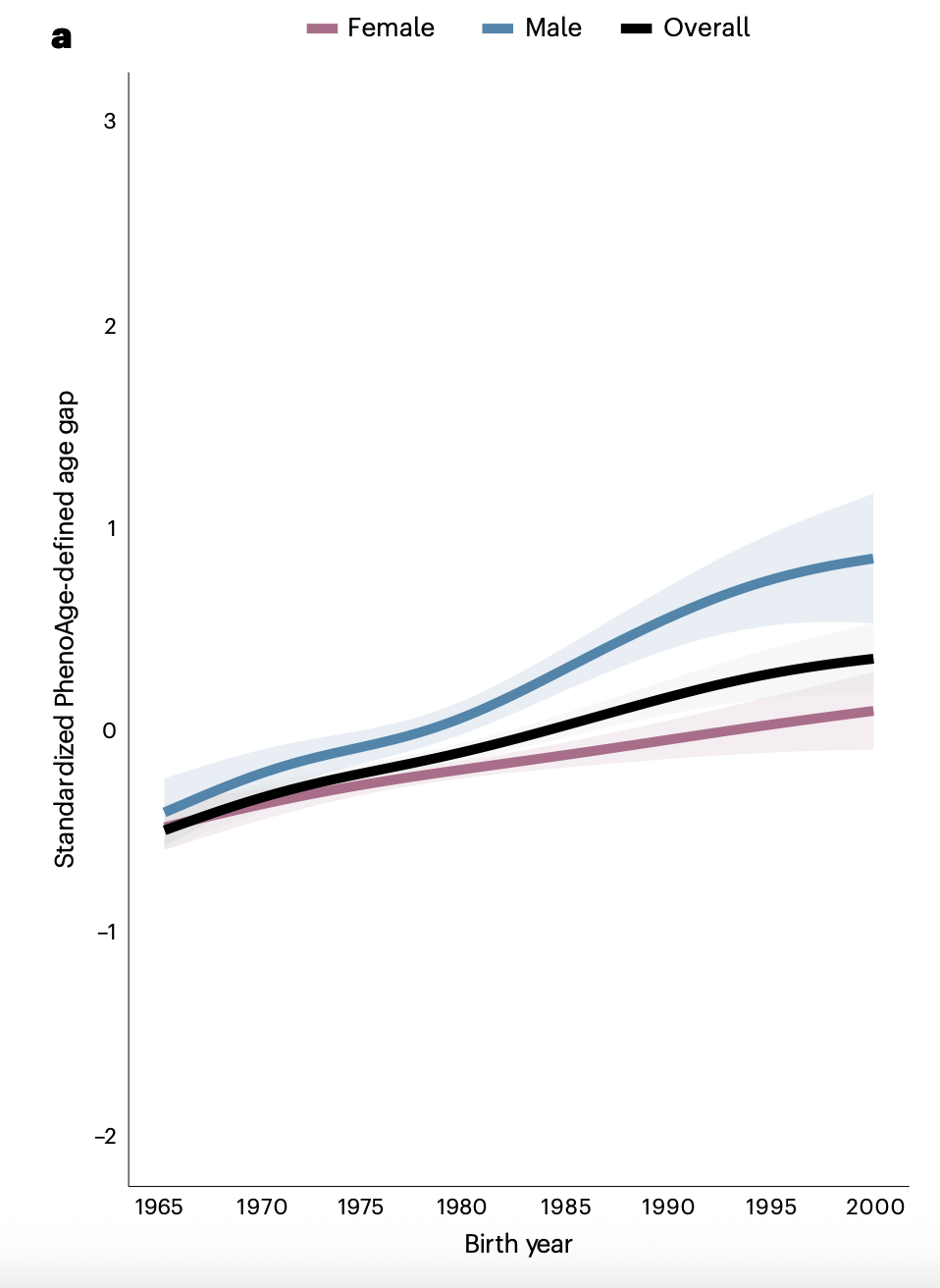
*This figure from the study shows the increase in the age gap over time.
They then looked at association with early-onset cancer. People with higher biological age had a greater likelihood of developing early-onset cancers.
Researchers found that for each incremental increase in their measure of biological aging, the risk of developing an early-onset solid cancer increased by about 8%. This doesn't mean that every additional "biological year" increases cancer risk by 8%. Rather, it means that people with progressively higher biological aging scores had progressively higher risks of early-onset cancer. The strongest associations were seen for lung cancer, gastrointestinal cancers and uterine cancers. Interestingly, they did not see an association with breast cancer. Researchers also divided participants into three groups based on their degree of biological aging—from the lowest to the highest levels. Compared with people in the lowest group, those in the highest group had a 15% higher risk of developing an early-onset cancer.
These associations remained even after accounting for inherited genetic risk for both cancer and accelerated aging. When the researchers examined individual organs, they found that accelerated immune system aging was associated with early-onset lung cancer, while accelerated aging of adipose (fat) tissue was associated with early-onset colorectal cancer.
One of the questions they asked in the study was whether biological aging might help explain why lifestyle factors such as obesity and smoking increase cancer risk. They found that biological aging explained only a small portion of this relationship, telling us that lifestyle likely influences cancer risk through multiple biological pathways and not biological aging alone.
What can we take from this study?
As we attempt to understand why cancer rates are rising in younger adults, I think this study is really important. We must keep in mind that it is an observational study and while it suggests an association between accelerated biological aging and cancer, it does not prove it.
Although we don’t entirely know why younger generations are experiencing accelerated biological aging, it is likely the result of many factors acting together, rather than a single exposure. The authors of the study propose earlier and more sustained exposures to obesity and metabolic dysfunction, poorer diet quality, more sedentary time, circadian disruption, exposure to environmental chemicals, and broader social and environmental influences. The combination of these exposures may gradually alter the body's biology in ways that accelerate aging and potentially increase cancer risk. However, much more research is needed to understand which factors matter most and how they interact.
Interestingly, biological aging may have different effects depending on a person's age. Earlier in adulthood, accelerated aging may create conditions that make it easier for cancer to develop. Later in life, aging is also associated with reduced regenerative capacity and increased cellular senescence, changes that may limit the growth of some cancers.
Research using biologic aging may eventually help to better understand why cancer risk is changing across generations, identify people at higher risk and develop risk reduction strategies earlier in life. Will slowing biologic aging will reduce cancer risk? What are the best ways to slow biologic aging? What is the best measurement for biologic aging — these ‘aging clocks’ continue to evolve and are an active area of research.
What should we be doing?
Currently, we don’t currently have a validated way to measure your biological age in a way that changes cancer screening or treatment. However, many of the same behaviors associated with healthier aging are also associated with lower cancer risk:

Exercise regularly. Movement is medicine.
Eat a diet rich in fruits, vegetables, whole grains, and fiber. Limit processed and ultraprocessed foods.
Avoid smoking.
Limit/eliminate alcohol.
Prioritize sleep.
Manage diabetes, high blood pressure, and other metabolic conditions.
Maintain a healthy body weight. (I recognize that BMI is not the optimal measure here)
Stay up to date on recommended cancer screening. Get your mammograms, colonoscopies, Pap smears and more!
Maintain social connections and community.
These recommendations aren’t new but this study reinforces just how interconnected aging, metabolism, inflammation, and cancer may be. If you’ve been following the research on GLP-1 and reduction of cancer risk, I’m very interested to see how the use of GLP-1 medications may impact biologic aging.
The bottom line
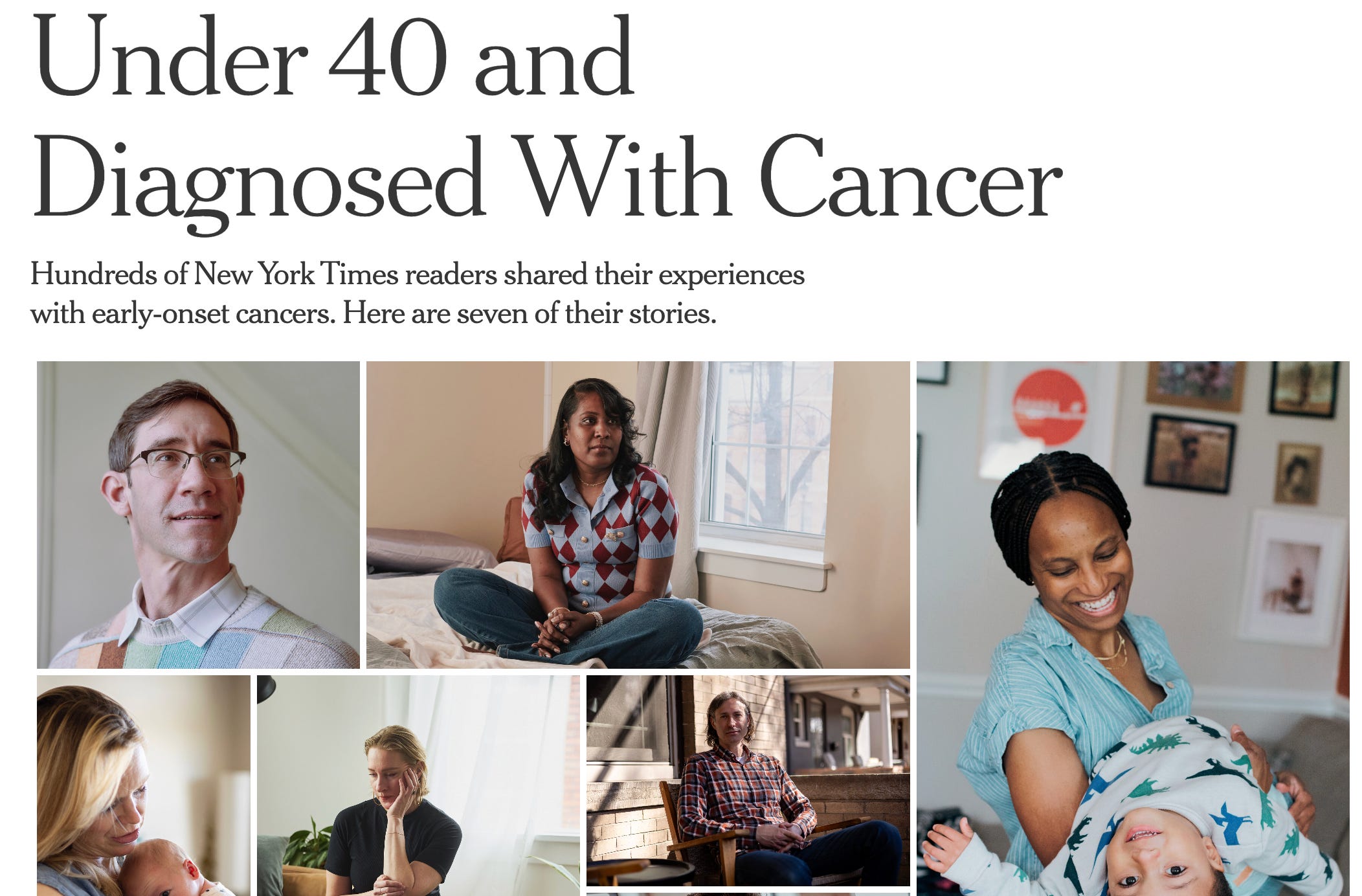
Early-onset cancers are increasing. Headlines like this one in the NY Times are increasingly prevalent:
This study provides a way to think about why this is happening. Rather than searching for one single cause, accelerated biological aging may reflect the cumulative impact of many modern exposures acting together over a lifetime. Although, we are still far from using biological age to predict an individual’s cancer risk and it’s important not to overinterpret a single study, I do think this is an exciting step toward understanding why younger generations are experiencing cancers that were once considered diseases of older adults. Let me know what questions you have!
In other news:
We are a little more than three months away from the release of my book, Beyond The Pink: Navigating Life, Health, and Breast Cancer. It is currently the #1 new release in the Oncology category on Amazon (I can’t believe it!). This week, you can also get 25% off at Barnes & Noble with the code PREORDER25. If you’ve pre-ordered, I hope you’ll join me for the Beyond The Pink Book Club for a virtual live event on July 22nd at 7pm EST (recording will be available if you can’t make it).

I’ll be talking about all things breast cancer and answering all your questions! If you’ve pre-ordered, sign up here! I can’t wait to see you there. (It’s on Zoom and you’ll be emailed the Zoom link a few days before the event).
American Cancer Society. https://www.cancer.org/cancer/latest-news/what-gen-xers-and-millennials-should-know-about-cancer-risk.html.
Tian R, Zong X, Ren D, Tica S, Hong D, Oduyale O, Buenrostro JD, Govindan R, Cao Y. Biological aging and generational shifts in early-onset cancer risk. Nat Med. 2026 Jun 22. doi: 10.1038/s41591-026-04448-w. Epub ahead of print. PMID: 42332142.
This is a careful writeup, and you flag the finding I think matters most almost in passing: biological aging explained only a small part of the obesity-and-smoking link to cancer.
The framing everywhere is aging-as-explanation, but that mediation result reads more like the clocks being a correlated readout of the same exposures than the pathway the risk actually travels. A marker riding alongside the mechanism, not the mechanism. The organ-specific hits fit that too: immune aging with lung, adipose aging with colorectal look like the exposure surfacing in whichever tissue it taxes most.
Hi, I just found you and am enjoying your posts... thanks for taking the time to write and share. 😀